You came home three days ago. There is a newborn who needs feeding every two hours, an incision that pulls every time you sit up, and a discharge summary that says “review after six weeks” and almost nothing else.
Nobody sat you down and explained what you are actually allowed to do. Can you climb stairs? Lift your older child? Is this much pain normal, or is something wrong?
This guide answers those questions in order. It covers c-section recovery week by week, what helps and what sets you back, the signs worth acting on immediately — and the problems that can appear months later, long after everyone has told you that you are healed.
These C-Section Recovery Do’s and Don’ts are guided by Dr. Dipak S. Kolte, a Best Gynecologist in Ravet with 16+ years of experience in cesarean deliveries and postpartum care at Kolte Hospital.
How Your Body Heals After a C-Section?
A caesarean is abdominal surgery. That single fact explains most of what follows.
To reach your baby, your surgeon opened several layers — skin, fat, the fibrous sheath, muscle and finally the uterus. Each layer is stitched, and each heals at its own pace.
The skin closes first. Within a week or two, it looks settled, which is exactly why so many women overdo things in month two. The deeper layers, especially the sheath that holds your abdominal wall together, take considerably longer. Full strength returns closer to three months than six weeks.
So the six-week mark is not a finish line. It is the point at which most women are safe to resume normal activity — not the point at which healing is complete.
Your Recovery, Week by Week:
Your own c-section recovery time may run faster or slower than this. An emergency caesarean, a long labour before surgery, anaemia or twins all stretch the timeline, and that is completely normal.
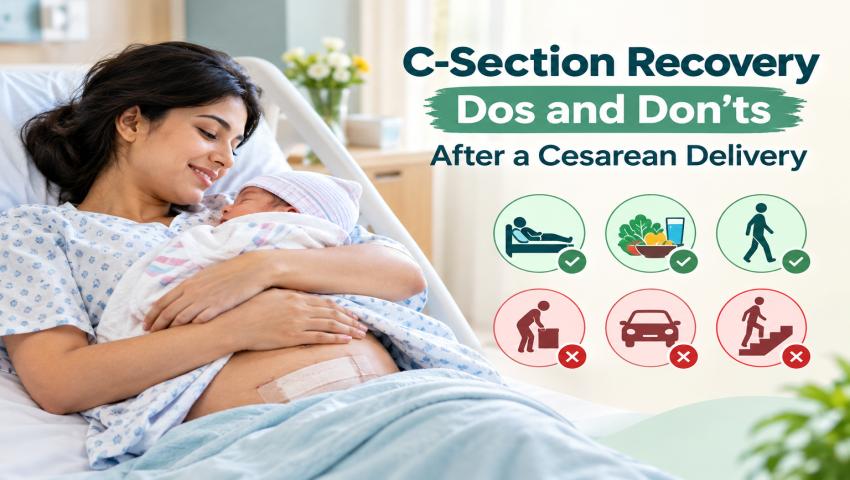
What You Should Do After a C-Section?
- Start walking early — short, frequent walks from day one reduce clot risk and speed healing
- Support your incision with a folded towel when you cough, sneeze or stand
- Take pain relief on schedule, not only when it becomes severe; controlled pain after cesarean delivery means you move more, and moving more helps you heal
- Keep the wound clean and dry, washing gently with plain water
- Eat protein and iron-rich food and drink plenty of fluids
- Rest when your baby rests — sleep is part of the treatment here
Our detailed guide to precautions after a caesarean delivery covers diet, breastfeeding and emotional wellbeing in more depth.
What You Should Avoid After a C-Section?
- Lifting anything heavier than your baby for six weeks — careless lifting after c-section strains the deeper layers before they are strong
- Driving until you can brake hard without hesitating and your doctor has cleared you
- Repeated stair climbing in the first week or two
- Tight shapewear or binders unless specifically advised
- Scrubbing, picking or applying random creams to the wound
- Tampons, douching or intercourse until your six-week review
- Pushing through pain — pain after activity is a signal, not a weakness
How to Take Care of Your Scar?
- Clean with plain water and pat dry; keep soap off the wound for the first two weeks
- Leave it uncovered once your doctor confirms it has closed
- Wear loose cotton clothing so nothing rubs against the line
- Once fully healed, gentle c-section scar care with massage using a plain moisturiser softens the tissue
- Keep the scar out of direct sun for the first year to reduce darkening
- Mention any history of keloids early — treatment works better when started sooner
Signs You Should Not Wait On:
Contact Kolte Hospital the same day if you notice:
- Fever above 100.4°F, or chills
- Spreading redness, warmth, swelling or discharge from the incision
- The wound opening, or fluid leaking from it
- Pain in one calf, swelling, or breathlessness
- Bleeding that soaks a pad in an hour, or large clots
- Foul-smelling discharge
- Severe headache with blurred vision, or swelling of hands and face
Problems That Show Up Months Later:
Most women recover fully. But a caesarean can leave changes inside that only become obvious once life has returned to normal — and these are rarely explained at discharge.
- Pelvic adhesions: Internal tissue heals by sticking surfaces together, which can cause pulling pain with movement, painful periods or bowel discomfort.
- Caesarean scar niche: A small pouch can form where the uterine incision healed unevenly. The classic sign is brown spotting that continues for several days after your period has otherwise finished. It is also a recognised cause of difficulty conceiving again.
- Scar endometriosis: A firm lump near the scar that swells and becomes painful around your period each month.
These C-section scar problems are commonly missed, mostly because women assume anything to do with the scar was settled long ago. If you have ongoing pelvic pain, unusual bleeding, or trouble conceiving a second time a year or more after your delivery, it is worth investigating rather than tolerating.
How a Laparoscopic Surgeon Fixes Them?
All three are treated through keyhole surgery — small incisions, a camera, and repair done from inside rather than by reopening the abdomen.
Adhesions are carefully released. A scar niche can be repaired laparoscopically to restore the uterine wall, which often settles the abnormal spotting and improves the chance of a future pregnancy. Scar endometriosis is removed.
Assessment usually starts with an ultrasound, followed where needed by laparoscopic evaluation. At Kolte Hospital, Dr. Dipak S. Kolte performs these procedures alongside maternity and fertility care, so women who are trying to conceive again are assessed for both at the same visit. Following the right C-Section Recovery Do’s and Don’ts makes it easier to spot a problem early, and a problem caught early is far easier to treat.
Have ongoing pain, spotting, or trouble conceiving after a c-section? Contact Dr. Dipak S. Kolte, a Best Gynecologist in Ravet with 16+ years of experience, for a personalised assessment and a clear treatment plan.
Visit Kolte Hospital in Ravet, Pune, for complete maternity, gynecology, and fertility care under one roof. Book your appointment today and take the first step towards a healthier recovery.
Frequently Asked Questions:
Most women manage normal daily activity by six weeks, but the deeper abdominal layers regain full strength closer to three months. Tiredness and occasional scar twinges for several months are entirely normal.
Usually after six weeks, and only once you can do it without pulling at the incision. Dr. Dipak S. Kolte advises building up gradually rather than resuming heavy lifting on a fixed date.
Brown spotting for several days after your period ends can indicate a caesarean scar niche. It is easily assessed on ultrasound and should not simply be tolerated.
Usually not. But adhesions and a scar niche can both make conception harder. Dr. Dipak S. Kolte recommends an assessment if you have been trying for a year or more after a previous caesarean.